
Posted on 20 July, 2026 in category: Interviews | Tags: Art, Education, Interview, Science, Thales + Friends
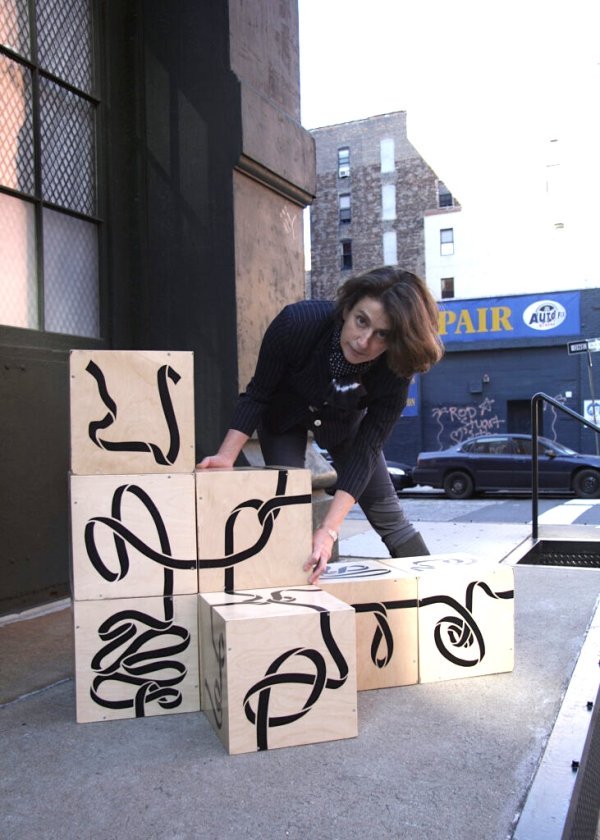
Zoe Keramea alongside the sculptural ensemble “Nine Cubes”
Interview by George Karouzakis
In the work of the Greek visual artist Zoe Keramea, scientific precision meets artistic play through a sustained exploration of form and space. Through sculpture, printmaking, drawing, and ceramics, the artist reveals the possibilities of folding: from the two-dimensional surface of paper to the intricate three-dimensional structures of her works, a distinctive world emerges, one in which knots, folds, and topological paradoxes acquire material presence.
With an international profile and projects that often require the viewer’s active, embodied participation, Zoe Keramea invites us to discover the hidden geometry of reality. She has held more than twenty solo exhibitions, and her work has been presented in major museums around the world. Her career includes significant milestones: from representing Greece at the 18th Biennale of Sydney in 2012, where her drawing Journey Lines became the visual identity of the event, to her participation in the Homo Faber Event in Venice in 2022 and in the exhibitions Bridges: Mathematics and the Arts in the United States in 2024 and in the Netherlands in 2025. Her most recent solo exhibition, Transformations, was presented with great success in 2025 at the Hellenic American Union’s exhibition spaces in Athens.
Zoe Keramea, who lives and works between Athens and New York, was born in Athens and completed her studies as a Meisterschülerin at the University of the Arts Berlin. She has also invented her own printmaking technique, which she calls zoetype. In the following conversation, occasioned by the lecture on her work that took place on Friday, 16 January 2026, at the Enastron Book Café in Athens, as part of the events organized by the THALES + FRIENDS group, she speaks about her creative path, the relationship between art and science, and the fascination of transforming a simple strip of paper into sculpture.
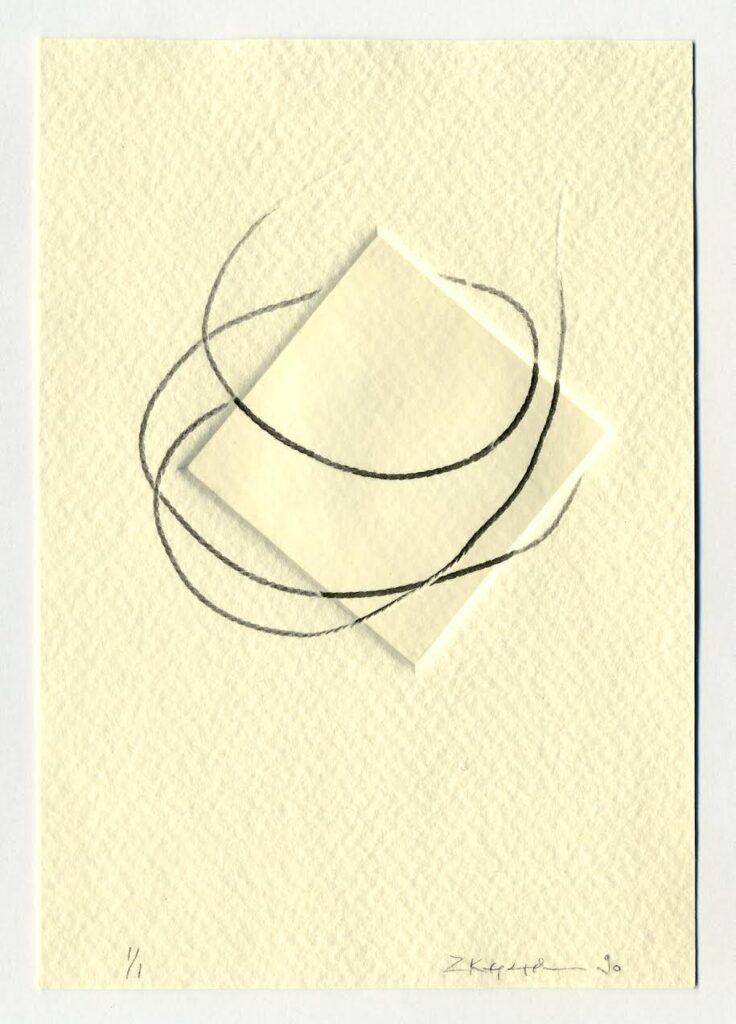
“Circling the Square”, Intaglio-zoetype
You began your career by studying arts traditionally described as two-dimensional, such as printmaking and painting. Yet your work evolved into an exploration of “folding objects”. What creative need led you from flat paper into three-dimensional space?
When I was working intensively on printmaking, drawing ribbons tangled into knots onto the metal plate, I thought about incorporating the model itself, the ribbon, into the finished work. I started using the ribbons as printing plates, thus creating inked surfaces which would transfer the incised image from the metal onto the paper. This way of working opened a new path, allowing me to shape the flat surface of the image in many different ways: to enfold it, to warp it around, and even beneath another printing surface, creating the illusion of three-dimensional space on the paper. Out of these works came my interest in enfolded surfaces and knotting. My experiments in printmaking led me beyond the restricted frame in which traditional painting, drawing, and printmaking are often trapped.
When I was a Fulbright scholar at “Bob Blackburn’s Printmaking Workshop” in New York, I taught printmaking to a Japanese woman. She, in return, showed me how to fold a paper crane from a napkin using origami, just as her mother had taught her when she was a little girl. In 1991, preparing an exhibition in Berlin, I was staying with friends from my university years who by then had two young sons. I showed the children how to fold a square sheet of paper into a crane, and for days we folded cranes and decorated the Christmas tree. They called it a “Designer Baum”. And in his turn, the younger boy showed me how to fold a small box out of the same small piece of paper, as he had learned at school. I was fascinated by the manipulation of a flat surface and its transformation into volume. This is how the transition of the works from two to three dimensions began. Such an example is the work “Boxes”. The “Boxes” depict 12 knots: 6 black on white and 6 white on black, mirrored pairs. As the drawings are folded, the knots change form. These works shift between two- and three-dimensional.
Once folded into boxes, they can be arranged like a tiling puzzle horizontally or vertically, using some couples or all couples, or more than one set of 12. Drawn directly onto film for the offset printing, the 12 “Boxes” were each printed in an edition of 100, signed and numbered, and hand-folded by me. It is a limited edition multiple with references to symmetry, knots, topology, and tessellation.
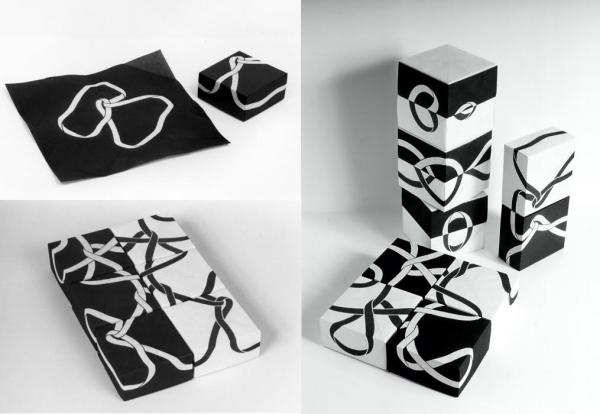
“Boxes”- Limited edition multiple consisting of 12 boxes
What were the starting points and sources of inspiration for your artistic work?
The handling of different materials, their subjugation, and my submission to them.
If you had to describe your work to someone unfamiliar with it, what is the one key idea you would want them to retain?
I play with the flat surface of an image, I allow the work to tease the viewer’s perception, to trick him. I often invite the viewer to play with the work; sometimes it becomes a game. What seems flat is turned and twisted, acquires volume, and changes form. Paper is the dominant material. I use it in printmaking, I draw on it with graphite or ink, and I fold it to create three-dimensional modular units, which I sew together into small and large paper sculptures. I also fold it and cut it with scissors and knives; the paper cutout forms the basis for artist’s books, ceramics, games, and brainteasers.
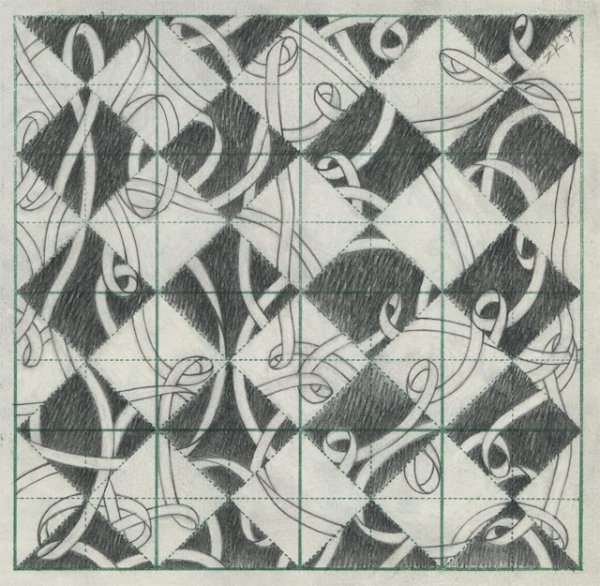
“Seek and Hide II” – Graphite drawing on Chinese calligraphy paper
Lines, knots, and geometric shapes dominate your work, and you use many media, including sculpture, printmaking, drawing, and ceramics, with images that often resemble “visual riddles”. What is the significance of this visual “vocabulary” and of your movement from one medium to another?
I was always interested in the study and exploration of traditional techniques. Knowledge of materials and intensive practice open new approaches to technique and multiple possibilities in the formation of a work. The transition from one medium to another and the way they complement each other increases my understanding of each separate medium. The enfolded surface, which fascinates me so much, lends itself naturally to the exploration of paradox.
You took part in the international Bridges 2025 conference, which brings together mathematics and art, with the work Dimoebius. What fascinates you about the topological structure of the Möbius strip? How can art visualize a mathematical paradox?
The Möbius strip is itself a flat surface that, when twisted in space, becomes three-dimensional. The sculpture “Dimoebius” is a double Möbius strip, which arose during its creation, hence its name. A third black Möbius strip is incorporated in this sculpture. For the construction of “Dimoebius,” I use flat strips of paper which are hand-folded into triangular dipyramids. In their turn, these strips of paper, when folded into polyhedra, become three-dimensional. The polyhedra are sewn with thread along their edges, creating a flexible surface. The work is defined by the process of its construction, which allows it to exist in many different stages, lying down or hanging. Art can visualize a mathematical paradox in many ways.
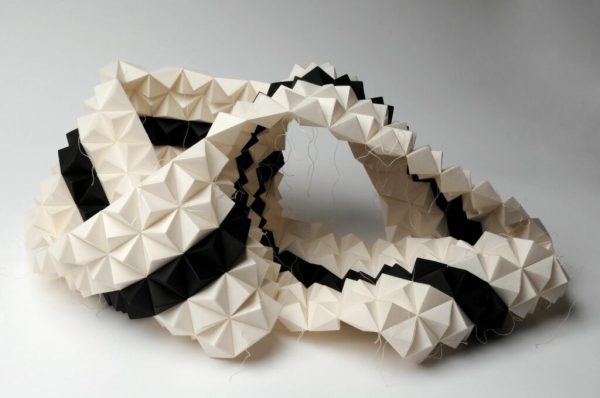
“Dimoebius” – Flexible sculpture consisting of paper trigonal dipyramids, hand-folded and sewn together with thread
Many of your works are sewn with thread, a practice that allows their structures to change. What is the significance of this choice?
Many of the works consist of modular units. These are strips of paper or metal hand-folded into trigonal dipyramids. The modular units are sewn together to form flexible modular structures or larger rigid modular units, which are used to construct larger sculptures. Due to their construction, the dimensions of the works vary. Being flexible, they can be continually transformed depending on their position in space. The multiplicity of variations is a very important element.
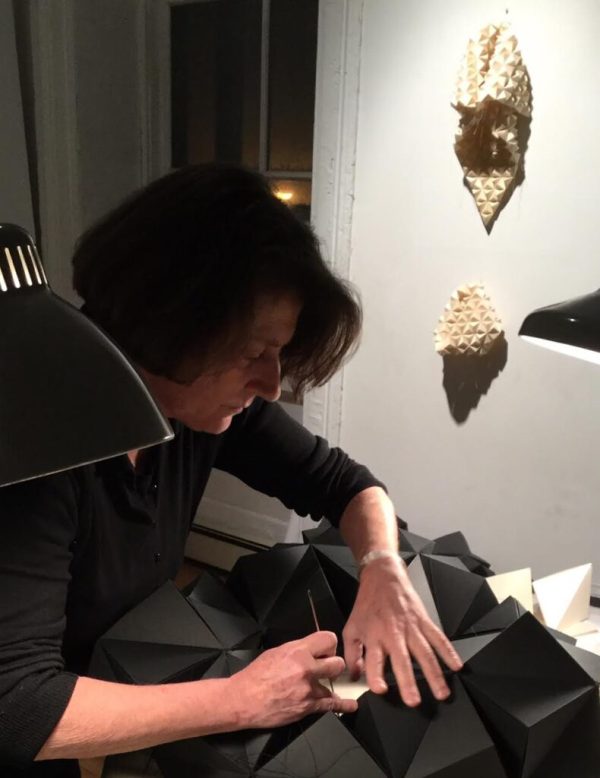
Zoe Keramea is sewing together paper modular units for the creation of a sculpture
One of your best-known works is Ringknot – A Woven Line, realized in public space in New York in 2006 with the participation of dozens of volunteers. How does one design a work in which collective participation is a structural element of the result? Do you believe that art ought to be an experiential process?
For three months, I prepared the construction of the work “Ringknot- A Woven Line” so that it could be completed in a single day. The work was created at South Street Seaport in New York, as part of the “Big Draw”, organized by “The Drawing Center” during the “River to River Festival” in September of 2006. I had to train six “Drawing Center” staff members to assist the public during the work’s realization, as well as a group of volunteers to show children how to weave bracelets using the same weaving technique. The project was covered by “The New York Times,” and more than 1,200 people participated under my guidance in weaving a gigantic circle out of thick nautical rope. It is a knot whose very shape symbolizes completion, dedication, and celebration. It is a trefoil knot. It consists of a single line woven into a circle. Where the two ends meet, the three-strand rope is unraveled at the ends and spliced together, vanishing into the body of the circle. The beginning and the end become one, disappearing into the completed “Ringknot”. The active participation of the public and its collaboration with the artist were essential for the creation of the “Ringknot”. Its weaving follows a predetermined path and specific instructions.
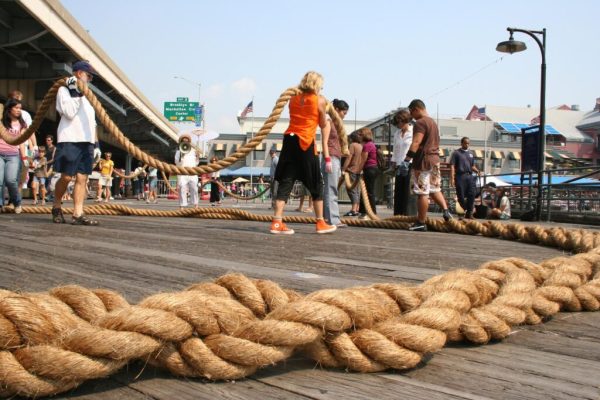
Ringknot – A Woven Line”- South Street Seaport, New York
In other works of art, such as the sculptural ensemble” Nine Blocks” presented at the Biennale of Sydney in 2012, the public is free to participate without any guidance or rules. The viewer is invited to move the blocks and form infinite combinations in space while maintaining the continuity of the ribbon that wraps around their surfaces.
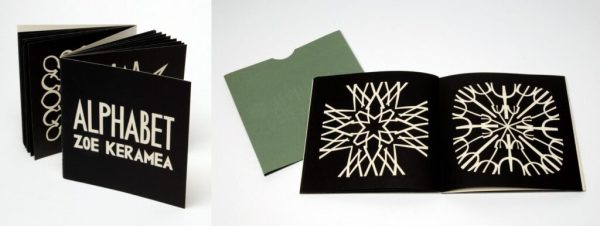
Alphabet”- Limited edition artist’s book signed and numbered in 500
Interactive games and puzzles are also available, such as Alphabet, Zebra, Zoeknots, Serpentine, Eight Boxes, Mirror Match, Numbers, and others. However, art does not have to be an experiential process. One can also perceive and enjoy it in solitary contemplation or reflection.
We live in an age in which science seeks precision, while art often pursues interpretation and emotion. In your work, these elements merge. Do you think that the artist and the scientist share the same fundamental anxiety: the need to bring order to chaos or to reveal the hidden structure of the world?
They may share the same fundamental anxiety, but they approach the hidden structure of the world from diametrically opposite directions. The artist creates his or her own world, which is resourceful, inventive, and interpretive. The scientist investigates the world in which he or she exists, examining it through logic and methodology.
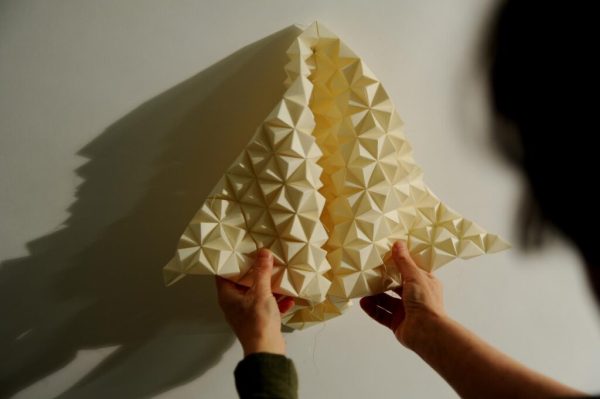
Zoe Keramea with the flexible sculpture “White Moth”
Several of your works recall patterns found in nature, from crystalline lattices to molecular structures. Is this scientific “resemblance” intentional, or does it arise organically? Do you believe there is a universal “grammar” of form, shared by nature and human creation?
Any scientific resemblances in my work that evoke nature are not intentional; they arise organically. Human creation refers to nature, comments on it, draws forms from it, and elaborates them; it makes use of nature
To close this conversation, is there a message you would like to send to our readers, perhaps about the relationship between art and science?
In art as in science, continuous meticulous observation brings new forms and new perceptions to the surface.
For more information about the artist’s work, click here


© Copyright 2001-2026 Thales + Friends.
designed & developed by UNICORG EE